

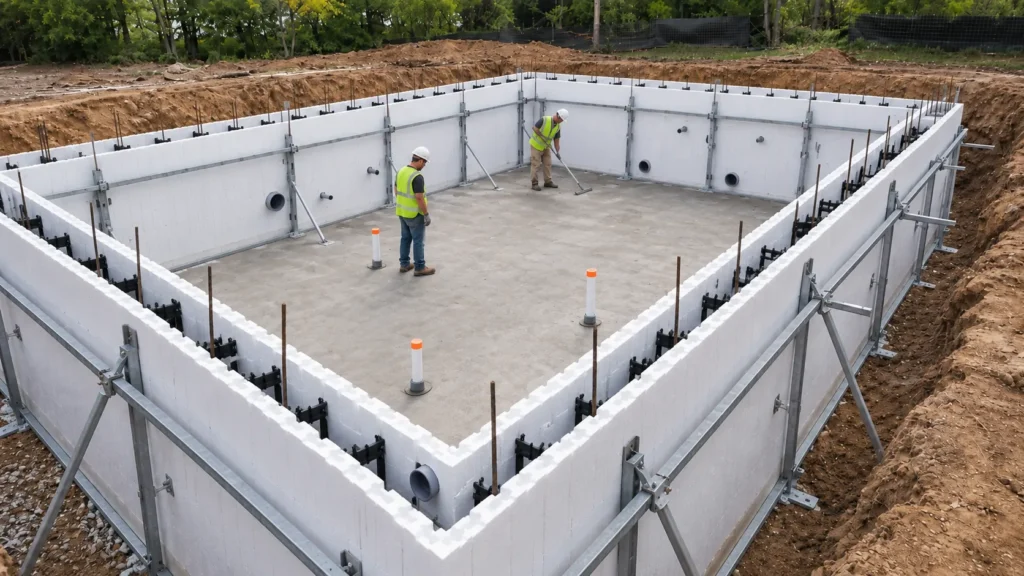
A swimming pool shell has to do more than hold water. It must cope with pressure from the water inside, pressure from the surrounding ground, changing conditions when the pool is emptied, and numerous penetrations for fittings and services.
ICF blocks for swimming pools provide permanent insulating formwork around a reinforced concrete core. The forms establish the wall shape, concrete creates the primary structure, and the insulation remains in place afterwards.
This makes ICF relevant where the design requires both a reinforced concrete shell and permanent wall insulation. It does not remove the need for structural engineering, waterproofing, reinforcement or careful detailing.
Why Swimming Pool Walls Need Careful Structural Design
Pool walls are exposed to loads that can act in different directions.
When the pool is full, water pushes outward against the shell. When it is empty, the surrounding soil and groundwater may act against the outside of the wall without the internal water pressure balancing those forces.
That means a pool wall cannot be designed around one loading condition alone.
The structural engineer may need to consider:
- pool depth and wall height;
- ground conditions;
- groundwater level;
- internal water pressure;
- external soil pressure;
- steps and benches;
- openings and penetrations; and
- the connection between the walls and base slab.
Guidance from The Concrete Centre on reinforced concrete swimming pools also emphasises that pool design involves more than simply specifying “waterproof” concrete. Structural behaviour, crack control and watertightness need to be considered together.
Where ICF Fits Into the Pool Structure
ICF is the formwork system around the concrete, not a replacement for the structural concrete itself.
The blocks are stacked to create the wall geometry, with reinforcement positioned inside the hollow core according to the engineer’s design. Concrete is then placed between the insulating faces.
Once cured, the wall generally consists of:
- permanent insulating forms;
- a reinforced concrete core;
- waterproofing or lining appropriate to the design;
- internal finishes; and
- any required external drainage or protection.
The concrete carries the main structural loads. The ICF forms stay around it and provide insulation while remaining part of the wall build-up.
The formwork should therefore not be credited with performance that belongs to the complete reinforced concrete pool structure.
What Does the Insulation Contribute?
For a heated swimming pool, limiting heat transfer through the shell can form part of the wider energy strategy.
ICF leaves insulation around the concrete wall after construction, so the wall does not require the same separate insulation stage as an otherwise uninsulated concrete shell.
However, wall insulation is only one part of pool energy performance.
Heat loss can also be influenced by:
- evaporation from the water surface;
- whether a pool cover is used;
- the pool base;
- pipework and plant;
- air movement;
- ventilation in indoor pools; and
- the heating system.
In practical terms, the insulation is incorporated into the wall build-up rather than added as a separate layer afterwards.
That does not mean ICF alone makes a pool energy efficient.
Waterproofing Is Still a Separate Design Issue
An ICF pool should not be described as waterproof simply because it uses a concrete core.
Watertightness depends on the complete structure and its detailing.
The areas most likely to require careful coordination include:
- wall-to-base junctions;
- construction joints;
- skimmers;
- water inlets and outlets;
- underwater lighting;
- pipe penetrations;
- steps and benches; and
- movement joints where these are required.
Poor detailing at a single penetration can compromise the watertightness of an otherwise well-designed shell.
This is why pool waterproofing should be resolved before the concrete pour rather than treated as a finishing decision.
The Base Slab and ICF Walls Have to Work Together
The pool walls cannot be considered separately from the base.
The wall-to-floor connection influences both structural behaviour and watertightness, so it should be resolved before the ICF wall is assembled.
That normally means coordinating:
- starter reinforcement;
- the position of the wall on the slab;
- the construction joint;
- any water-retaining details;
- pipework passing through the shell; and
- the relationship between the base and groundwater.
This is particularly important for in-ground pools.
If groundwater is present, an empty pool may be exposed to external hydrostatic pressure. That condition has to be considered within the project-specific engineering rather than assumed away.
How the ICF Pool Wall Comes Together on Site
Once the structural arrangement has been established, the forms can be assembled around the proposed pool perimeter.
Set Out the Pool Geometry
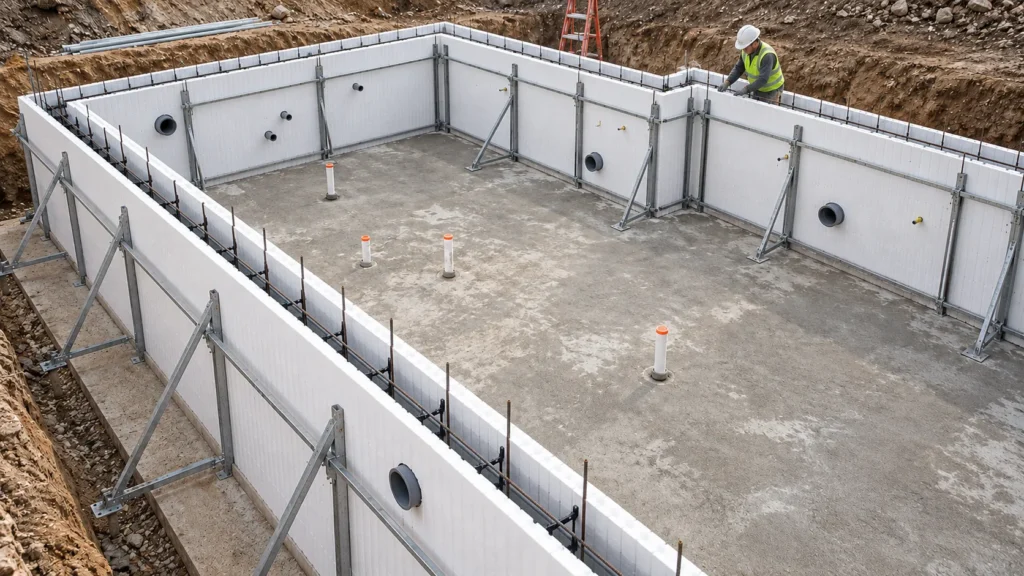
The ICF blocks are positioned to establish the wall shape.
Simple rectangular pools are relatively straightforward to set out, while steps, seating, unusual corners or curved areas require additional coordination.
Position Reinforcement and Fittings
Horizontal and vertical steel is installed to the structural drawings.
Pool fittings should also be planned before concrete placement wherever possible. Sleeves, penetrations and embedded components are easier to coordinate during construction than to introduce through the completed shell later.
For more technical projects, our information for engineers and civil teams explains the type of product data and system information we can provide to support professional design decisions.
Brace the Forms Before the Pour
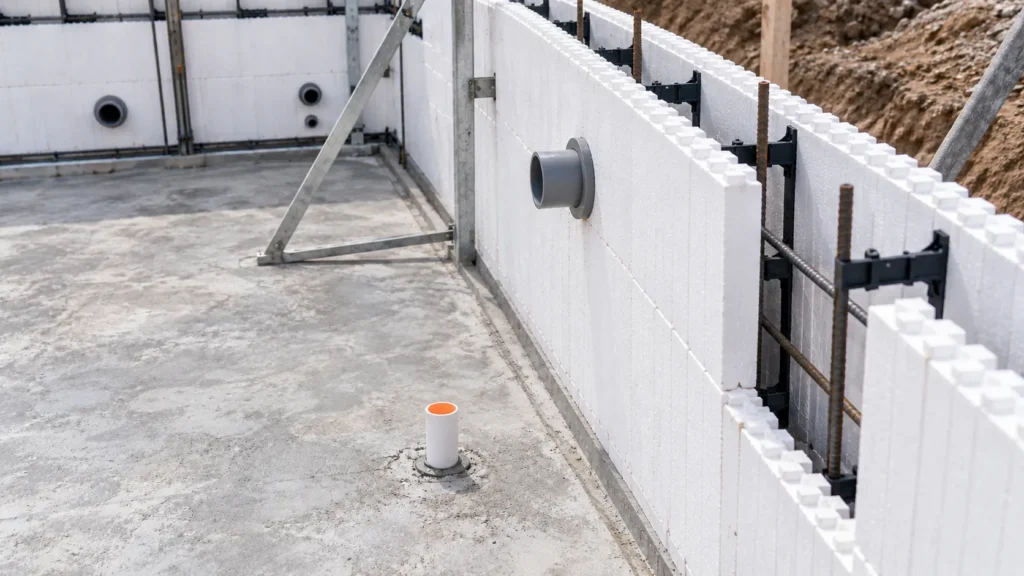
The wall needs to remain aligned while concrete is placed.
The bracing system, access and concrete placement sequence should follow the requirements of the chosen ICF system.
Place the Concrete
Concrete is then poured or pumped into the formwork.
The specification and placement sequence should come from the structural design and current system guidance rather than being copied from another pool project.
Careful placement is particularly important around reinforcement, corners and penetrations where congestion can make complete filling more difficult.
ICF and Conventional Concrete Pool Walls Compared
Both approaches can create reinforced concrete swimming pool walls, but the role of the formwork differs.
| Consideration | ICF pool wall | Conventional shuttered concrete wall |
| Formwork | Remains as part of the wall | Normally removed after curing |
| Main structure | Reinforced concrete | Reinforced concrete |
| Wall insulation | Incorporated in the forms | Usually added separately if required |
| Structural design | Project-specific | Project-specific |
| Waterproofing | Separate design requirement | Separate design requirement |
| Form stripping | Not normally required | Usually required |
The appropriate method depends on how the structure, insulation, waterproofing and construction sequence are intended to work together.
What About Larger or More Complex Pools?
ICF should not be treated as a universal solution for every pool type.
Large public, competition or commercial pools can have very different requirements from a private domestic pool. They may involve more complex movement, circulation, spans, interfaces and maintenance considerations.
Sport England’s swimming pool design guidance treats pool construction as a specialist design exercise.
Its more detailed construction guidance is cautious about permanent formwork in larger pool applications and recommends independent specialist advice rather than assuming the same approach is suitable at every scale.
For larger or unusual pools, the structural engineer, waterproofing specialist and pool designer should be involved early.
Choosing the ICF Form for a Pool
There is no single ICF block specification that suits every swimming pool.
Before choosing a form, the design team should already understand:
- concrete core requirements;
- wall thickness;
- reinforcement;
- pool depth;
- insulation targets;
- groundwater conditions;
- waterproofing strategy;
- finishes; and
- the location of fittings and penetrations.
At Insubloc, we supply a range of Nudura ICF systems with different form and insulation configurations. Insubloc is also listed within Nudura’s approved UK ICF partner network, which provides an independent reference for our relationship with the manufacturer.
Product selection should follow the structural design, required concrete core, thermal targets and proposed finishes rather than the pool application alone.
If you are comparing formwork options for a proposed pool, explore our ICF product range and review the available systems alongside your structural engineer and pool design team.
What Matters Most Before You Build
Using ICF does not remove the specialist parts of pool construction.
The quality of the finished shell still depends on coordinated decisions about structure, concrete, reinforcement, waterproofing, groundwater, services and finishes.
ICF combines permanent formwork and wall insulation around the reinforced concrete core. Where that arrangement suits the wider pool design, it can be a practical option to assess alongside conventional shuttered concrete construction.
Technical note: This article provides general information only and is not a structural, waterproofing or swimming-pool design specification. Pool structures should be designed for project-specific water, ground and groundwater loads. Follow the appointed structural engineer’s design, current manufacturer guidance and applicable technical requirements.
